safeandsecure.ie/topics/personal/personal-alarms
Personal alarms, and the free Seniors Alert Scheme
If you are 65 or over, with limited means, and live alone, you may be able to get a monitored personal alarm free, through the Seniors Alert Scheme. Ask a local community group. This guide also covers paying for one, and small alarms for when you are out.
Last checked against the sources listed at the end of this page.
We sell nothing on this page. It has no affiliate links, and nobody paid to be on it.

The short answer
- “Personal alarm” means two different things: a button you wear at home that rings a helpline (opens in a new tab), and a small handheld alarm that makes a loud noise when you are out.
- Aged 65 or over, with limited means, and living alone or alone for much of the day? Under the Seniors Alert Scheme, the alarm and its fitting are free (opens in a new tab), and so is the first year of monitoring. You apply through a registered local group, not on your own.
- Paying for one yourself? Before you sign, get the yearly cost, the length of the contract and what happens when you press the button, in writing.
Free help first
Aged 65 or over? The Seniors Alert Scheme
A monitored personal alarm for people aged 65 or over with limited means. The equipment and installation are free (opens in a new tab), and monitoring is free for the first year. Who can get it and how to apply are further down this page.
ALONE: support and befriending for older people
ALONE’s National Support and Referral Line is open seven days a week from 8am to 8pm (opens in a new tab), on 0818 222 024. Ring it for advice, support or information, for yourself or for someone you care for. Its work includes befriending, by visits and by telephone (opens in a new tab).
Your neighbours: Community Alert and Text Alert
Community Alert is a community safety programme for rural areas, with an emphasis on older and vulnerable people (opens in a new tab). It is a partnership between the community, the Gardaí and Muintir na Tíre. Text Alert groups get texts about suspicious or criminal activity (opens in a new tab) in their area. Our guide to Text Alert, Neighbourhood Watch and Community Alert explains how to join one.
Free smoke alarms, if cost is a difficulty
If you find it hard to afford a smoke alarm, or an alarm for someone who is deaf or hard of hearing, you may be able to get one free through the Community Smoke Alarm Scheme (opens in a new tab). Ask your local fire authority.
What is a personal alarm? There are two kinds
People mean two quite different things by “personal alarm”. This guide covers both, and they are worth keeping apart.
1. At home: a monitored alarm you wear
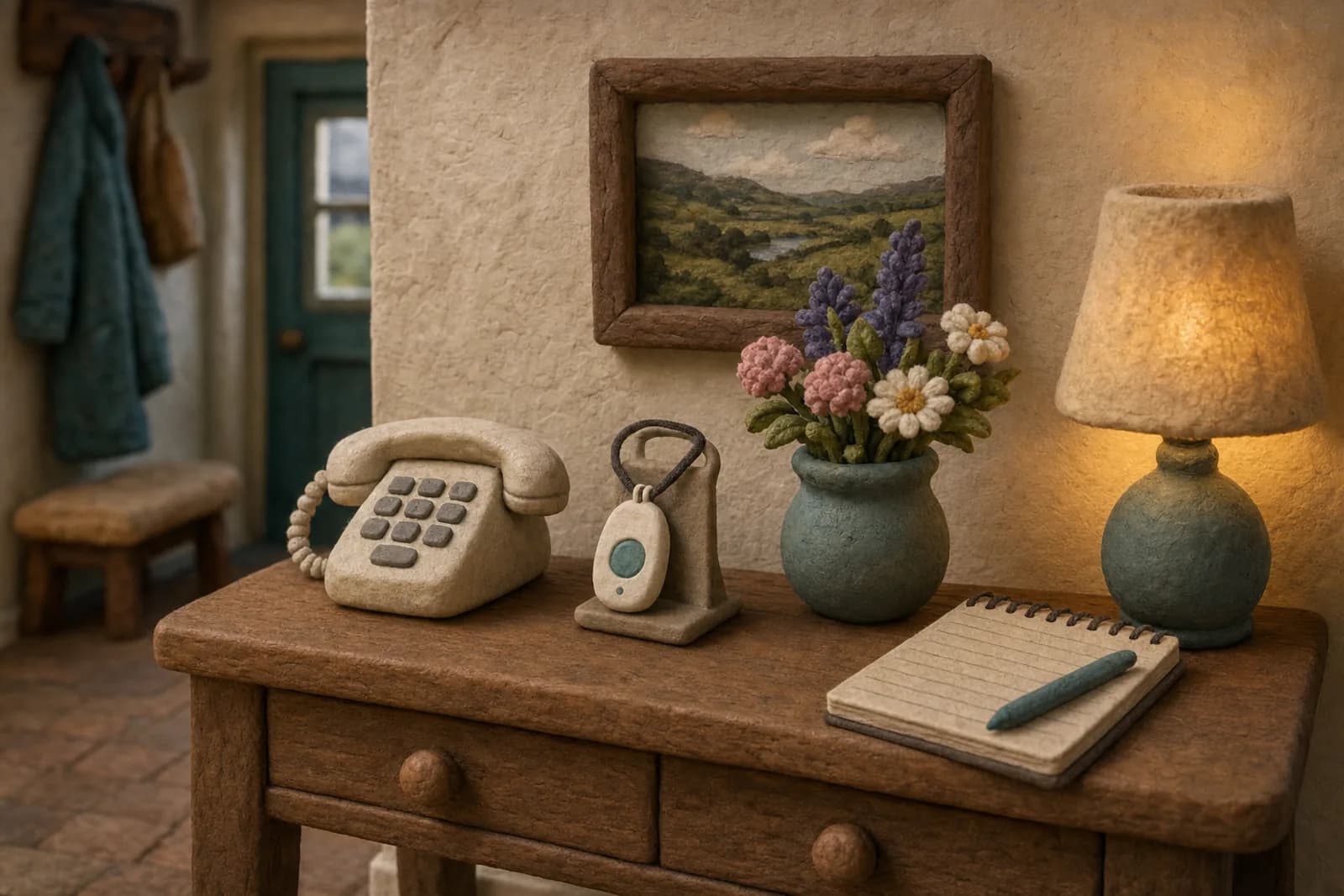
A button you wear as a pendant, or on your wrist like a watch (opens in a new tab). It connects through a base unit in your home to a helpline, where someone answers when you press it. The free Seniors Alert Scheme gives one of these.
Read: the Seniors Alert Scheme, then paying for one yourself.
2. When you are out: a handheld alarm
A small alarm you carry, which makes a loud noise when you set it off, to draw attention to you. It does not take the place of ringing 999 or 112.
What is the Seniors Alert Scheme, and who can get it?
The Seniors Alert Scheme helps older people to live securely and independently in their own homes (opens in a new tab). It provides a monitored personal alarm. It is funded by the Government and run by Pobal (opens in a new tab), through local community and voluntary groups.
Who can get it
Citizens Information says you must be (opens in a new tab):
- aged 65 or over, and
- of limited means.
And any one of these:
- living alone;
- alone for long spells during the day;
- living with another person aged over 65 with limited means; or
- caring for someone else in your household.
You must also live in an area that a registered group covers, be able to benefit from the equipment, and be willing to keep in touch with the group.
What it costs
Free: all the alarm equipment and its installation (opens in a new tab), and the monitoring for the first year.
After the first year: you pay a yearly monitoring fee. It varies with the provider and the kind of alarm. In Citizens Information’s words, “The cost may be approximately €70 a year.” (opens in a new tab) Your local group can tell you the cost in advance.
No landline? The alarm can use a mobile signal instead, and then you may have to pay for SIM rental (opens in a new tab).
How it works
You wear the button as a pendant or on your wrist. A base unit in your home connects it to a national helpline. When you press the button, it rings the helpline at once (opens in a new tab). The helpline is open 24 hours a day, all year round. The operator talks to you in your home and decides whether to alert a local volunteer responder or, if needed, the emergency services.
The equipment belongs to the local group. If you no longer need it, it must be given back (opens in a new tab).
How do I apply, or apply for a parent?
Only through a local group. Pobal does not accept applications from individuals (opens in a new tab). You contact a community or voluntary group registered with Pobal in your area, and the group applies for you.
Finding the group. Pobal lists the registered groups by county, with their contact details (opens in a new tab). If you are stuck, ring Pobal on 01 511 7222 (Monday to Friday, 10am to 12.30pm and 2pm to 4pm) or email [email protected].
Applying for someone else. If the person can’t apply themselves, a family member or neighbour can apply for them (opens in a new tab) with the local group.
What the group does
- Checks whether you are eligible (opens in a new tab), and helps you fill in the form.
- Works out the equipment you need, and tells you the current cost of monitoring, and of SIM credit if you need it.
- Sends the application to Pobal.
You will be asked to confirm that you understand what the equipment is for, and that you will pay the yearly monitoring fee after the first year.
Not eligible? What to ask before you pay for a monitored alarm
If the scheme does not fit, you can pay a company for a monitored personal alarm. We don’t name companies or prices. What matters is what happens when the button is pressed, and what you have agreed to pay. Ask these questions, and get the answers in writing before you sign.
Questions to ask the company
- What happens when I press the button? Who answers, and where are they?
- Is the line answered 24 hours a day, every day of the year?
- Who do you contact: my family, a neighbour, the emergency services? In what order?
- How quickly do you answer, and how quickly can someone get to me? Can I have that in writing?
- What does it cost each year, all in: equipment, fitting and monitoring? In writing, please.
- How long is the contract? How do I end it, and is there a fee to leave?
- Does it need a landline, broadband or a mobile signal? What happens if I change provider?
- Who owns the equipment, and what happens to it if I stop?
- How do I test it, and how often?
A house alarm is different. Alarm monitoring is a licence category of its own (opens in a new tab) with the Private Security Authority (PSA), under the standard PSA 33:2014. If the same company offers to monitor a house (intruder) alarm for you too, check its licence first: our guide to house alarms in Ireland shows how. The PSA’s pages that we read do not say whether answering a personal alarm needs a PSA licence, so we don’t say it does.
What about an alarm for when I am out?
A handheld alarm is a small thing you carry. It makes a loud noise to draw attention to you. It can only help if you can reach it, so keep it in your hand or on a wrist strap when you walk somewhere quiet, not at the bottom of a bag.
What to look for
- Can you set it off with one hand, quickly, without looking? Try it before you rely on it.
- How do you test it? Read the instructions, and test it now and again.
- What battery does it take, and how will you know when it is running low?
- Sold Secure, a security testing house in England, tests personal attack alarms and lists the ones it has approved (opens in a new tab). If an alarm says it is Sold Secure approved, you can check that on the list.
What the Gardaí advise when you are out
From the Gardaí’s “Streetwise” personal safety sheet (opens in a new tab):
- Plan how you will get there and how you will get home. Tell people where you are going and how long you will be.
- Your mobile phone is the street thief’s number one target. Avoid making or taking calls in public; if it rings, try to answer it in a public building rather than on the street. Keep it out of view.
- Choose well-lit places, and avoid dark places for walking or parking.
- Do not struggle with a thief: you may injure yourself.
- If you are attacked, report it to the Gardaí straight away.
Our personal safety page has more on staying safe when you are out.
Which other alarms should be in the house?
A personal alarm only calls for help when someone presses it. A smoke alarm and a carbon monoxide alarm raise the alarm themselves, even when you are asleep. They are worth checking whenever you set up a personal alarm.
Smoke alarms
From Fire Ireland’s advice:
- At least one smoke alarm on each floor (opens in a new tab). For the most protection, one in every room except the bathroom, kitchen and garage, and a heat alarm in the kitchen.
- On the ceiling, as close to the middle of the room as you can.
- Test it once a week: press and hold the test button until it sounds. Change the battery every year, and replace the alarm before its expiry date.
- For someone who is deaf or hard of hearing, there are units that connect to the alarm and use a strobe light and a vibrating pad (opens in a new tab).
Carbon monoxide alarms
Carbon monoxide is a poisonous gas with no colour and no smell (opens in a new tab). Having appliances, vents, flues and chimneys inspected and serviced is the best protection (opens in a new tab); an alarm adds to it. Gas Networks Ireland says:
- Choose one that meets the European standard EN 50291 and carries the CE mark and a mark of independent certification. It should have an “end of life” indicator, and it must sound: a light alone is no use if you are asleep.
- Put one in every room that has a fuel-burning appliance, and one within 5 metres of every bedroom.
- Test it every month, and replace it when it reaches the end of its life.
- It does not replace a smoke alarm.
For more, see carbonmonoxide.ie or ring 1800 89 89 89.
Setting up an alarm for someone who lives alone, step by step
For a parent, a neighbour or yourself. The checklist below has the same steps, with room to write the details down.
- 1
Talk it over first
It is their home and their choice. An alarm only helps if the person is happy to wear it. - 2
Ask about the free scheme
Find the registered group for the area on Pobal’s list, by county (opens in a new tab). If the person can’t apply themselves, a family member or neighbour can apply for them (opens in a new tab) with the group. - 3
Agree who will be called
Ask who the helpline will contact, and give the names and numbers of family or neighbours who live near enough to call round. - 4
Sort out a key
Make sure someone who may be called has a key, or knows how to get in. - 5
Wear it, and know how to test it
A pendant left in a drawer can’t call anyone. Ask the group or provider how to test the alarm, and how often, and write it down. - 6
Check the smoke and carbon monoxide alarms while you are there
Press and hold the test button on each one until it sounds. - 7
Print the checklist
Fill it in together, and keep it by the phone.
Setting up an alarm for someone who lives alone
Print this page and go through it together. Tick each line, and write the helpline’s number, the people it will ring and the testing instructions in the notes. Keep it by the phone.
The personal alarm
Who answers when the button is pressed, and what happens next
Write the helpline’s number in the notes.
The people the helpline will contact, with their numbers
Family or neighbours who live near enough to call round.
Who has a spare key, so that help can get in
The pendant or wristband is worn at home, not left in a drawer
How to test it, and how often, as the group or provider says
The base unit stays plugged in and switched on
The group or provider is told before the phone line or broadband changes
The yearly monitoring fee: how much, and when it is due
On the Seniors Alert Scheme, monitoring is free for the first year.
Around the house
A smoke alarm on every floor, tested every week
Press and hold the test button until it sounds. Change the battery every year.
A carbon monoxide alarm in each room with a fuel-burning appliance
And one within 5 metres of every bedroom. Test it every month.
Numbers by the phone
Emergency: 112 or 999. ALONE’s support line: 0818 222 024 (8am to 8pm, every day).
From safeandsecure.ie/topics/personal/personal-alarms. Last checked 6 October 2026. Sources: Citizens Information (citizensinformation.ie) and Pobal (pobal.ie): Seniors Alert Scheme; Fire Ireland (fireireland.ie); Gas Networks Ireland (gasnetworks.ie); ALONE (alone.ie); An Garda Síochána (garda.ie).
Print this
The checklist prints on one page, in black on white, with a box to tick beside each line and lines for notes. The whole guide prints without the menus, and with the address of every source.
One thing to do this week
Ask a local community group about the Seniors Alert Scheme.
Find the group for your area on Pobal’s list, by county (opens in a new tab), or ring Pobal on 01 511 7222 (Monday to Friday, 10am to 12.30pm and 2pm to 4pm). Asking for a parent? You can make the call. And if you ever need help in an emergency, ring 999 or 112 (opens in a new tab).
Sources
Every fact on this page comes from one of these, and each was read on 6 October 2026.
- Seniors Alert Scheme (page edited 19 November 2024) (opens in a new tab)
Citizens Information. Who can apply; equipment and installation free; monitoring free for the first year, then a yearly fee that varies and “may be approximately €70 a year”; a possible SIM rental fee without a landline; how the pendant and the 24-hour helpline work; returning the alarm; applying only through a registered group, which a family member or neighbour can do for you; what the group does.
- Seniors Alert Scheme (SAS) (opens in a new tab)
Pobal, which runs the scheme for the Government. Who is eligible; the Government funds it and Pobal runs it; the registered local organisations, by county, with their contact details; Pobal’s line for the scheme, 01 511 7222, its email address ([email protected]) and its opening hours, Monday to Friday, 10am to 12.30pm and 2pm to 4pm.
- Standards required for licensing (opens in a new tab)
Private Security Authority (PSA). Alarm monitoring is a licence category of its own, “Security Guard (Alarm Monitoring)”, under the standard PSA 33:2014.
- Personal attack alarms (approved products) (opens in a new tab)
Sold Secure, a security testing house in England. Sold Secure tests personal attack alarms and lists the ones it has approved.
- Personal Safety: “Streetwise” (information sheet PS2, March 2015) (opens in a new tab)
An Garda Síochána, Garda National Crime Prevention Unit. Plan your journey there and back and tell people where you are going; the mobile phone is the street thief’s number one target; do not struggle with a thief; choose well-lit places; report an attack to the Gardaí at once; 999 or 112.
- Detection: smoke alarms (opens in a new tab)
Fire Ireland (Department of Housing, Local Government and Heritage). At least one smoke alarm on each floor, at most one in every room but the bathroom, kitchen and garage; a heat alarm for the kitchen; test weekly, battery yearly; the Community Smoke Alarm Scheme; alarms for people who are deaf or hard of hearing.
- Carbon monoxide alarms (opens in a new tab)
Gas Networks Ireland. Choose an alarm to EN 50291 with the CE mark and an independent certification mark; one in every room with a fuel-burning appliance and one within 5 m of every bedroom; test monthly; not a substitute for a smoke alarm or for servicing; carbonmonoxide.ie and 1800 89 89 89.
- National Support and Referral Line (opens in a new tab)
ALONE. ALONE’s line for older people, 0818 222 024, seven days a week from 8am to 8pm.
- Our work (opens in a new tab)
ALONE. The kinds of support, including befriending by visit and by telephone.
- Community Alert (opens in a new tab)
An Garda Síochána. A community safety programme for rural areas with an emphasis on older and vulnerable people, run with Muintir na Tíre.
- Text Alert (opens in a new tab)
An Garda Síochána. Community groups that get alerts about suspicious or criminal activity in their area.